01TANK
Tanks & vessels
Storage, blending, fermentation and high-shear tanks — agitated or still, jacketed or not, with the outlet where the vessel actually drains.
500–120,000 L3 / 4 mm shell
Specification
Tanks, sterilisers, CIP and installation piping — supplied as one scope with defined battery limits, from 1 to 50 tonnes per hour.
A beverage line is a chain of interfaces. Ours begins at raw-material intake and ends at the process outlet, where your filling line takes over. Stating that boundary plainly is what makes a single-responsible scope possible — and it keeps the quotation comparable with the one you already have.
If your enquiry includes these sections, we will still answer it and tell you exactly which parts are not ours. On the sections we do take on, a unit we integrate keeps its maker's name on the drawing — we would rather say whose machine it is than blur where responsibility sits.
Three equipment families, and the installation that connects them — piping, electrical, PLC — as the fourth line of the quotation. Deaeration, plate heat exchangers, pumps, valves and instruments are integrated around them. One interface, one set of drawings, one responsible party.
Storage, blending, fermentation and high-shear tanks — agitated or still, jacketed or not, with the outlet where the vessel actually drains.
Plate pasteurisers and tubular UHT units, sized to the holding curve — with heat recovery and automatic flow diversion on deviation.
Compact three-tank skids and split systems, with conductivity, temperature and flow verification on every circuit.
The fourth line is a scope, not a catalogue frame: sanitary product piping, in-section power piping, electrical cabinets and PLC programming, executed on site by our engineers — priced in the quotation, drawn on the same P&ID the equipment was built to.
Deaeration removes dissolved oxygen; sterilisation kills micro-organisms. They sit next to each other in the line and do different jobs — neither replaces the other.
No renders, no stock photos. Our workshop and loading yard — a steriliser line awaiting FAT, CIP sets in assembly, vessels in production, and completed equipment leaving for site.
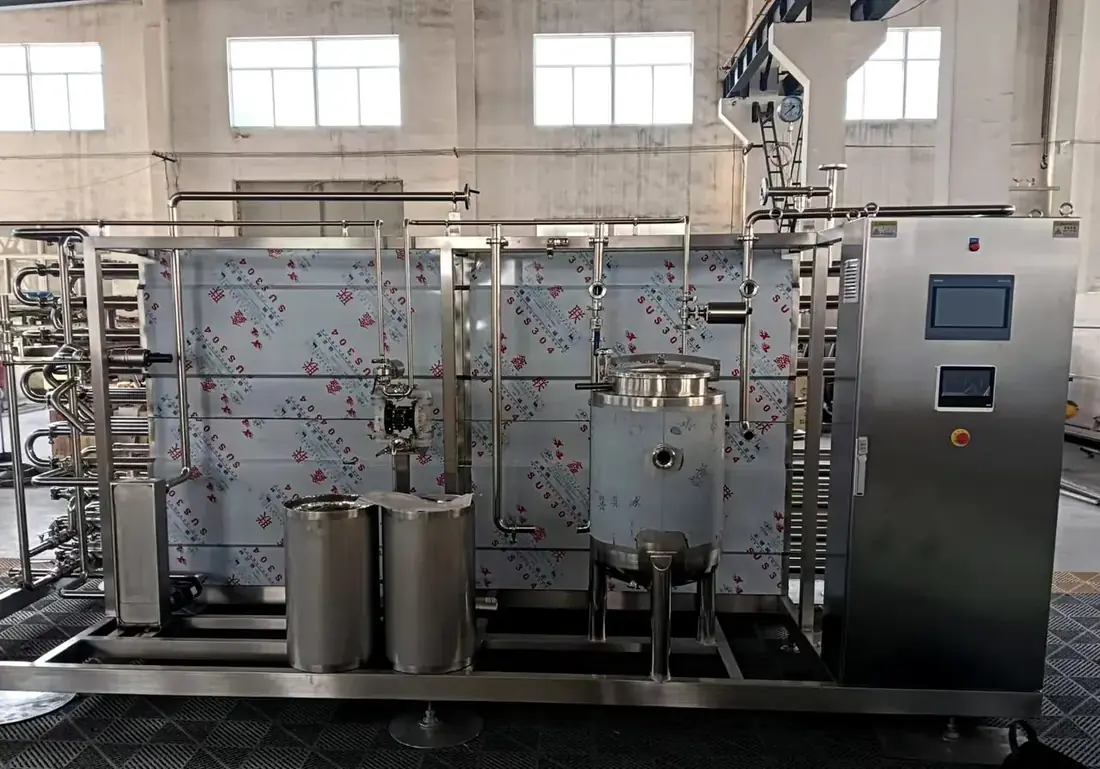
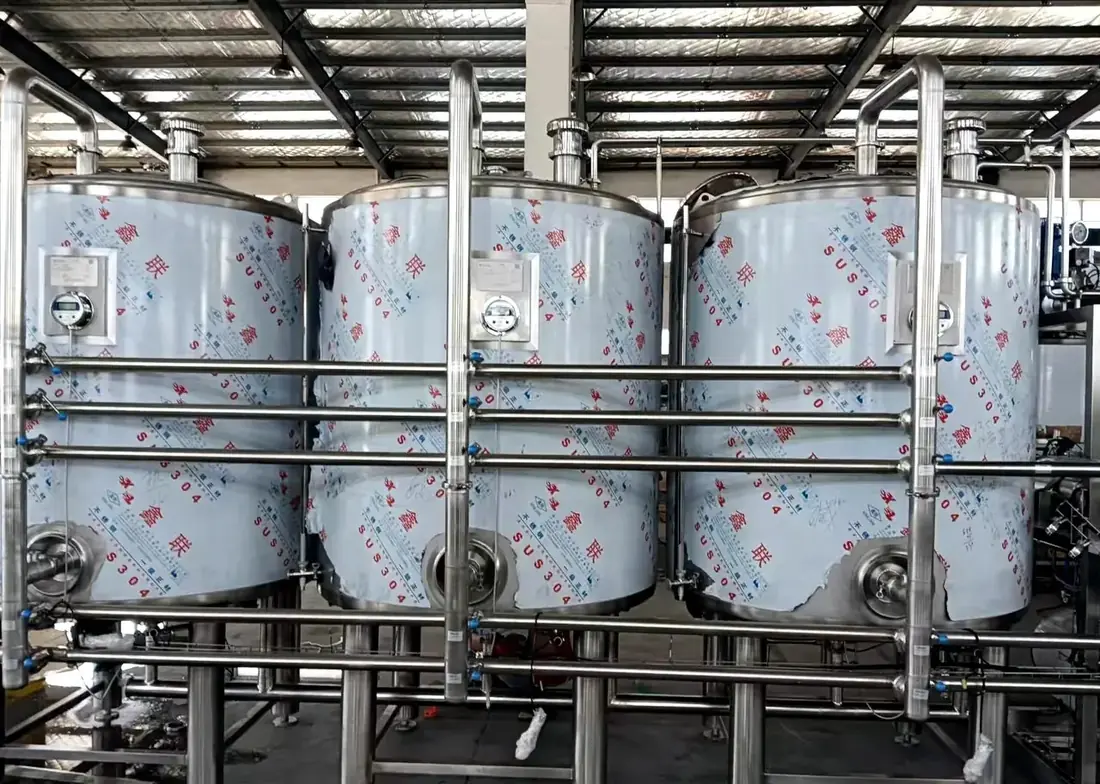
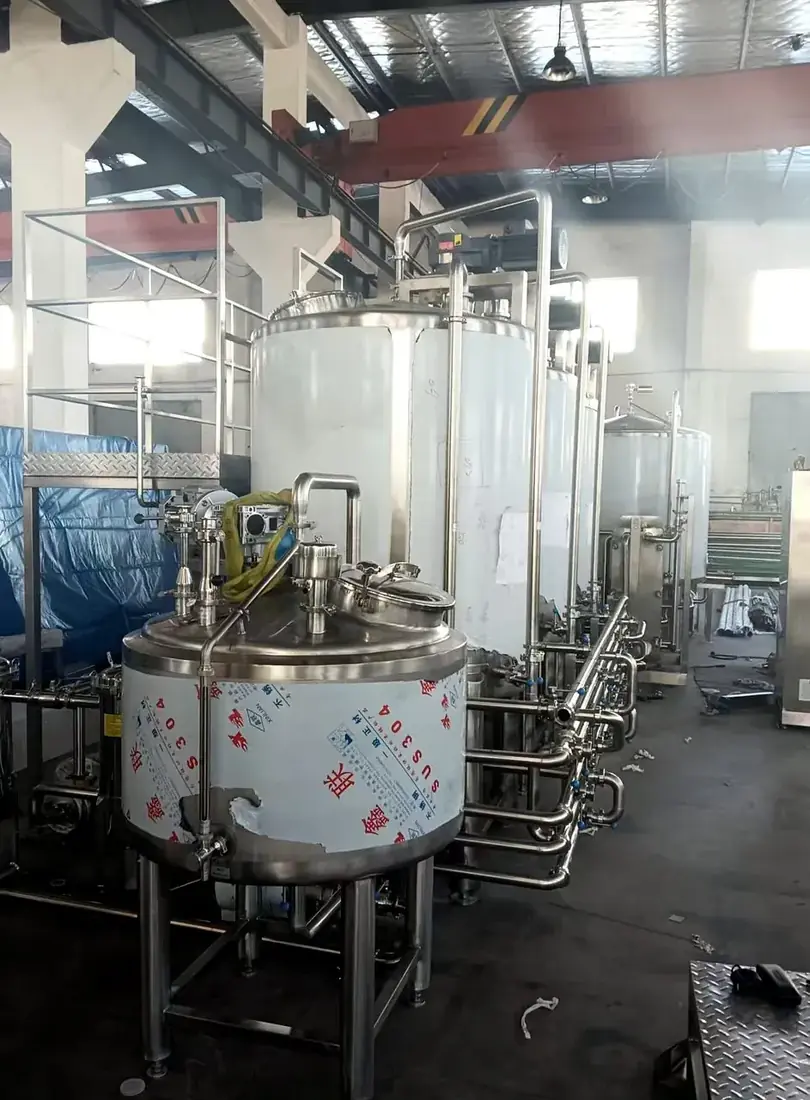
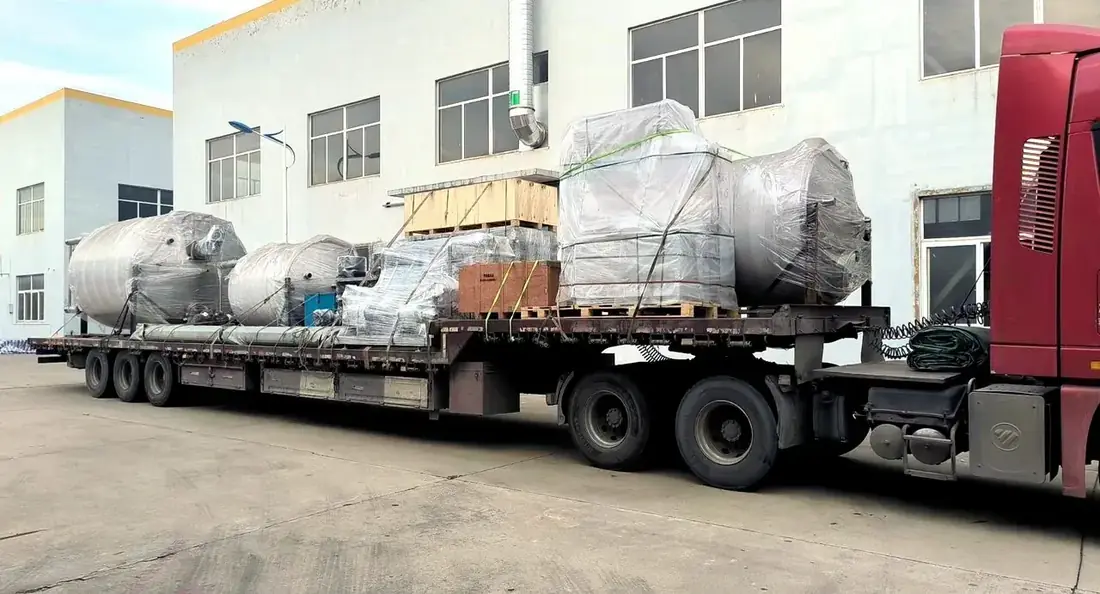
The sequence is conventional. What differs is that every stage is sized from the same product data, so the deaerator is not oversized against the steriliser, and the CIP circuit actually reaches the last valve.
Recipe-based dosing, agitation and temperature control, with inline °Brix monitoring.
Dissolved oxygen removed under vacuum to protect flavour and shelf life.
Plate or tubular, sized to the required time–temperature curve with heat recovery.
CIP circuits designed with the piping, not added afterwards — verified by flow and conductivity.
PLC recipes, alarm history and batch records for traceability at the process outlet.
We separate completed installations from contracts in execution. A reference list that mixes the two is not a reference list — it is a pipeline.
Sized for ≥45 t/h and ≥3 bar at the filler inlet, supplied through the EPC contractor. Contracted 15 June 2026; contractual delivery 15 July 2026. End client not named under the confidentiality clause.
Delivered and invoiced. Blending, heat treatment and CIP for a carbonated soft-drink line.
Installations across Russia (including Chechnya), Kazakhstan, Morocco, French Polynesia, Afghanistan, Pakistan, Malaysia, Indonesia and Vietnam — carbonated, juice and tea lines.
Kenya 3 t/h juice and carbonated; Sudan 10 t/h juice; Chad 22.5 t/h carbonated plus 9 t/h juice. Listed separately because they are not yet completed installations.
Our quality system operates to ISO 9001 principles. We do not hold a third-party ISO 9001 certificate, and we do not apply a CE mark as a manufacturer. What we can hand over with every machine is more specific — and it survives an audit.
For export projects we design and document to the applicable directives — Machinery 2006/42/EC, LVD, EMC and PED 2014/68/EU — and issue a declaration of conformity and technical file per project. Where a directive requires a notified body, we engage one and quote it separately.
From 20 January 2027 the Machinery Directive is replaced by Regulation (EU) 2023/1230; new projects are documented against the regulation where the delivery date requires it.
Product, capacity, °Brix, heat treatment and destination are enough to start. You will get a scope definition, a preliminary layout and a quotation — not a catalogue.